

Key Takeaways
- The Customer Service Revolution: Traditional methods lead to long wait times and inconsistent information. AI virtual assistants meet the modern customer demand for instant, 24/7, personalized support. 80% of customers prefer bots for straightforward matters.
- Beyond the Old Chatbot: Modern AI assistants are defined by Intelligence and Adaptability, moving past rigid, rule-based scripting. They are powered by:
- Natural Language Processing (NLP): Allows the AI to understand the user’s intent, context, and sentiment, not just keywords.
- Machine Learning (ML): Enables the assistant to learn from every interaction, continually enhancing its accuracy and effectiveness without constant manual adjustment.
- High-Impact Benefits for Business: Implementing AI assistants results in significant gains:
- Massive Scale: Handles thousands of queries simultaneously, keeping costs and wait times low during peak demand.
- Personalization: Seamlessly integrates with CRM and databases to provide hyper-personalized support and product recommendations.
- Cost Reduction: Automates routine tasks, freeing up substantial budget spent on staffing large human teams.
- Agent Empowerment: Takes over monotonous tasks, allowing human agents to focus on high-value, empathetic, and creative problem-solving.
- Key Real-World Applications: AI assistants are versatile tools:
- Intelligent Routing: Gathers context and seamlessly hands off complex issues to the correct human agent.
- Proactive Engagement: Reaches out to customers based on data triggers (e.g., abandoned carts, service alerts).
- Global Reach: Offers instant, consistent support in multiple languages via NLP.
- The Strategic Asset: Every interaction fuels data collection, providing invaluable insights into customer pain points and trending issues, enabling continuous improvement across the entire organization.
Today’s customers expect instant assistance and support tailored for them, but companies often find it difficult to provide that kind of support 24×7. Customers often experience frustrating wait times and receive inconsistent information. Reports indicate that over 60% of users will leave the phone queue if they are made to wait more than a minute. This presents a real problem for customer satisfaction and retention.
The answer comes in the form of AI-driven virtual assistants. These modern solutions are fundamentally altering the way businesses deliver support. Almost 80% of customers say they prefer to interact with AI bots for straightforward matters. That shows how effective they are at giving immediate answers.
This focus on intelligent customer support is a vital part of a broader strategy for efficiency and growth, as explored in our comprehensive guide on AI Automation for Business Growth.
In this blog post, we will be giving an introduction to how smart AI virtual assistants work and their practical applications. It will also explain how AI combined with customer service can make your operations better, and ultimately lead to more efficiency and happier customers.
So let’s learn first what AI-powered virtual assistants are and how they are different from the old chatbots.
What Are AI-Powered Virtual Assistants?
When we discuss AI-powered virtual assistants today, we’re discussing something far more advanced than today’s simple rule-based “chatbots.”
Many of those original chatbots were built on pre-scripted responses, keywords, or decision trees. If you asked them something a little differently than they expected, they got confused or gave you an “I don’t understand” answer.
A real AI Virtual Assistant is a sophisticated piece of software capable of mimicking human communication and actions. What makes them “AI-powered” is the extent to which they can understand, learn, and adapt, making the interactions feel much more natural and effective. Here’s what sets them apart:
Key Differences of AI Chatbots From Old Chatbots
Today’s AI-based virtual assistants are something else entirely. They are so smart, use very advanced technology to understand and learn, and everything is much smoother.
1. Natural Language Processing (NLP)
This is the key tech that enables an AI chatbot or virtual assistant to really understand human language – written or spoken. Unlike previous systems that merely hunted for keywords, NLP allows the AI to interpret the intent behind a user’s inquiry, the context of the discussion, and even sentiment (e.g., frustration, emergency).
As a result, you won’t have to ask your questions just right. It can pick up on variations, jargon, and colloquialisms which makes for much more fluid interactions.
2. Machine Learning (ML)
AI Virtual Assistants aren’t static. Machine Learning helps these systems to learn from each interaction they make. They monitor dialog for patterns, give the right answers and learn from their mistakes.
The more data an AI virtual assistant has to work with and the more interactions they manage, the smarter and more accurate they get. This helps enhance their ability to serve customers well, without having to constantly adjust them manually.
3. Seamless Integration with Business Systems
The great thing about the majority of AI and customer service solution technologies is the ability to integrate with your current business systems. This means that your virtual AI assistant can have real-time access to your Customer Relationship Management (CRM) system, ordering databases, knowledge-bases, or inventory systems.
This means they can show custom order updates, suggest related products, check customer history or stock levels on the fly and the experience will be a lot richer and more useful.
Now that you’ve got the basic understanding of virtual assistants, discover how businesses are leveraging them to revolutionize customer service.
How are Virtual Assistants Transforming the Customer Service Industry
The features of today’s AI-powered Virtual Assistants extend well beyond basic FAQs and are fundamentally reshaping how businesses engage with their customers and administer their support. The smart tools will not only enhance the process of existing services but also allow efficiency to reach its peak.
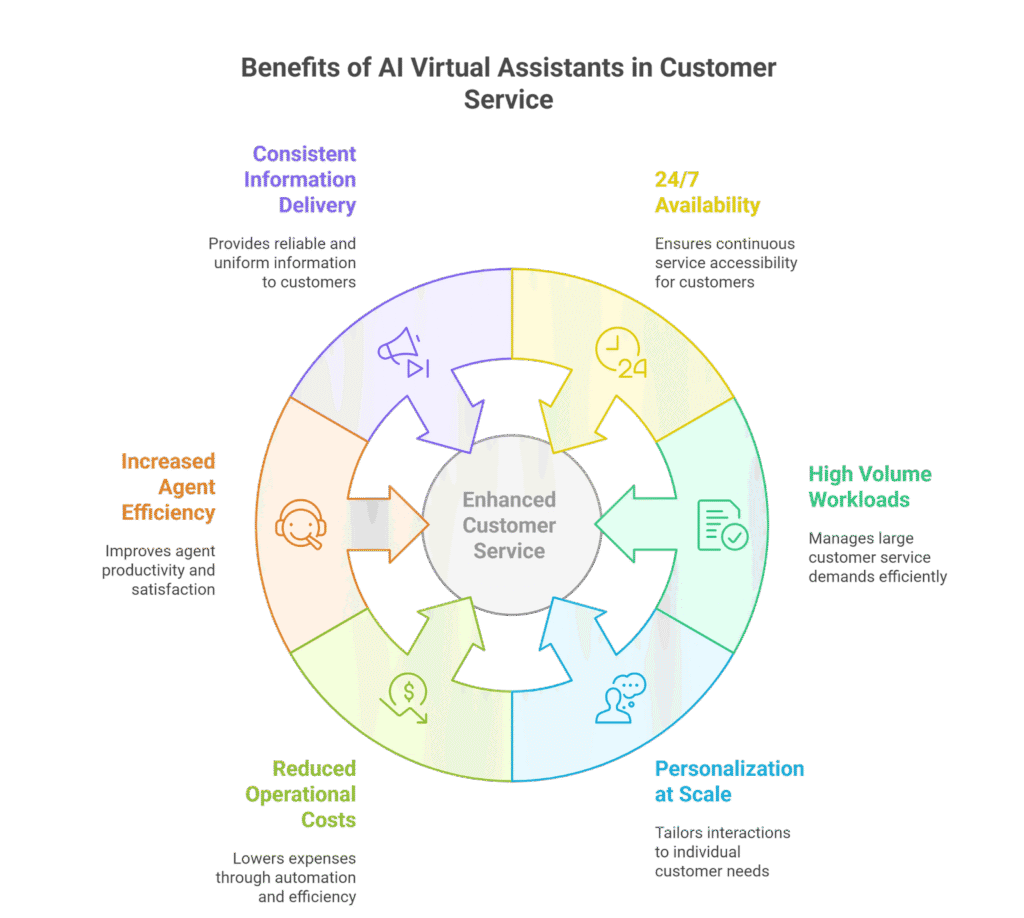
Here’s how AI is changing the way customer service works:
1. 24/7 Availability & Instant Responses
The most obvious and significant advantage of a virtual AI assistant is the fact that it never sleeps. An AI system can process requests around the clock without ever needing to take a day off. However, humans get tired and take breaks and shifts to juggle their workload.
Customers can get instant responses and help, no matter where in the world they are and whenever a question or a problem arises. There is no more waiting for the next available agent, so businesses can improve customer satisfaction and retention rates, particularly for global companies.
2. High Volume Workloads & Scale Operations
Customer service requests might soar during high season, marketing efforts, or some kind of unforeseen situation. AI chatbots are awesome at multitasking conversations, everything from handling thousands of queries and keeping customer wait time and labor costs down to a minimum.
This enables businesses to upscale customer support operations without having to increase human resource expenses which guarantee continuous service on very high demand.
3. Personalization at Scale
New AI Virtual Assistant technology can easily integrate and work with your Customer Relationship Management (CRM) and other systems of the businesses. This means they are able to tap into detailed customer information – what they have bought before, how they have interacted with the company, what their preferences are – in real-time.
With this data in hand, the virtual assistant can make hyper targeted recommendations, deliver personalized experiences, and greet customers by name. That way, everything feels tailored to them, even at scale.
4. Reduced Operational Costs
One of the most compelling benefits of AI when applied to customer service automation is the ability to save organizations a lot of money. By automating common questions and tasks that are asked and performed again and again, AI chatbots negate the need for constant human touch. This also frees up costly budgets which are usually spent on staffing vast customer service teams to be re-invested in organisations to other more strategic projects.
5. Increased Agent Efficiency & Job Satisfaction
Instead of replacing humans, AI and customer support tools will help them do their jobs better. Taking boring tasks out of the hands of human agents, the AI Virtual Assistants lets them focus on what humans do best – things that call for creativity and emotional empathy. This may mean human agents will become more efficient, less burnt out and more satisfied with their job through engagement in meaningful work.
6. Consistent Information Delivery
Even well-trained humans can give slightly differing responses sometimes. An AI chatbot, though, delivers consistent and accurate responses every time. Having been programmed with the correct information from your knowledge base, the virtual AI assistant will provide messaging that is uniform. This, in turn, will instill trust with interested customers. This uniformity is critical to adhering to the overall brand guidelines and preventing any confusion.
To witness these changes in action, let’s take a look at some real-life examples and the kind of work these AI assistants can handle.
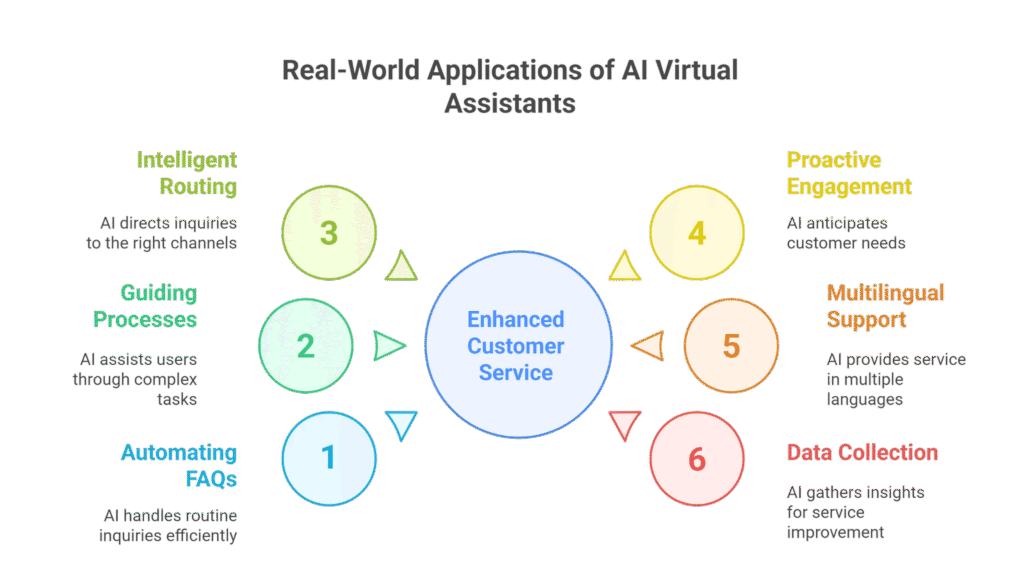
Real-World Applications of AI Virtual Assistants
The true power of AI-powered virtual assistants lies in their versatile applications of AI chatbots across numerous customer service interactions. They’re not just theoretical tools; they’re actively transforming how businesses large and small handle their daily customer queries.
Here are some of the key ways these intelligent systems are being deployed:
1. Automating FAQs & Routine Inquiries
This is probably the most used application of AI chatbots. An AI chatbot could respond instantly to FAQs like “What is the status of my order?” “Do you have any opening hours?”, or “How to reset the password on my account?” The virtual AI assistant uses a large knowledge base and provides accurate and instant responses while allowing human agents to focus on more complex tasks.
2. Guiding Through Processes & Basic Troubleshooting
AI Virtual Assistant can walk a customer through the steps of a process. This may include assisting them in creating an account, updating personal information, or scheduling correct order appointments. It can also talk them through simple troubleshooting for a product or service issue.
3. Intelligent Routing & Seamless Handoffs
In times when a customer’s question is too complex for the AI to resolve on its own, or when a customer wants to speak to a person, the AI and customer service system excel at intelligent routing. The virtual AI assistant can gather all context from the conversation, determine which department or specialist the customer needs, and seamlessly pass the customer to a human agent.
It also gives the agent a complete rundown of the interaction by that point. This way the information is not entered again and again.
4. Proactive Customer Engagement
AI isn’t just reactive. It is programmable to engage customers with predefined triggers or data. This might involve receiving an automated email reminder about an abandoned shopping cart or an appointment. It could also include alerts about SLA downtime in your locale or recommendations for items based on browsing history. It can even enhance customer satisfaction and drive sales.
5. Multilingual Support for Global Reach
In our interconnected world, companies have customers around the globe. One of the key benefits offered by AI chatbots is multilingualism. Powered by Natural Language Processing, they have the ability to understand and respond in multiple languages, ensuring all customers receive a first class support experience even if they speak different languages.
6. Data Collection & Insights for Continuous Improvement
Every conversation an AI-powered virtual assistant has is a bit of precious data. These systems automatically collect information about the customer pain points, typical questions, time to resolution, and customer satisfaction. Using this huge dataset, companies can learn how to improve their operations.
Conclusion: The Smart Choice for Modern Customer Service
The future of customer service has to be intelligent, and AI-driven virtual assistants are the perfect match. They are well beyond a simple conversation, providing a more efficient and much more scalable operation.
By providing 24/7 support, processing high volumes of queries, delivering personalized experiences and costing less operationally, businesses are able to satisfy — and even outperform — these modern customer expectations with the help of their virtual AI assistants.
The potential of AI chatbots is displayed through multiple use cases. They allow human agents to focus on nuanced, empathetic work, which is a path to a more productive and fulfilled workforce, and happier customers.
Ready to enhance your customer service with intelligent AI solutions? Nexifinity specializes in setting up and customizing AI-powered virtual assistants that seamlessly integrate with your operations, ensuring measurable improvements in efficiency and customer satisfaction. Contact us today to explore how we can help transform your customer service.
Are you prepared to take your customer experience to the next level with intelligent AI solutions? Nexifinity is focused on deploying and customizing AI-powered Virtual Assistants that intuitively work with your operations to drive measurable efficiency and customer success. Get in touch today to see how we can make the difference to your customer care.