

Key Takeaways
- Necessity, Not a Luxury: AI automation is essential for today’s businesses, moving beyond simple, rules-based tasks (“If X, then Y”) to intelligent, adaptive systems capable of learning, predicting, and making complex decisions.
- Core Technologies: AI automation is powered by a combination of technologies, including Machine Learning (ML) for pattern recognition, NLP for language understanding, Computer Vision (CV) for visual interpretation, and Generative AI for creating new content.
- The Real Value is Strategic: The advantages go beyond cost savings. AI fuels strategic growth by enabling Enhanced Decision-Making, Massive Scalability (24/7), superior Accuracy, and freeing human teams for Innovation.
- Myth Busting: AI is not just for large enterprises, cloud services have made it accessible to SMBs. It will also augment human jobs by automating routine tasks, not eliminate them.
- Widespread Impact: AI automation revolutionizes every department:
- Customer Service: Using sophisticated chatbots and sentiment analysis.
- Sales & Marketing: Automating lead scoring and content hyper-personalization.
- Finance & HR: Automating invoice processing, fraud detection, and candidate screening.
- Strategic Implementation is Key: Successful adoption requires a five-step roadmap: Define your measurable “Why,” ensure Data is clean and ready, Prepare your People through upskilling, Choose the right Partners, and Start Small, Learn, and Scale iteratively.
- The Future is Autonomous: The next step is Hyper Automation (automating every streamline-able task) and the rise of Autonomous AI Agents capable of handling multi-step tasks with minimal human involvement.
Businesses struggle when every minute mistake and inefficiency are magnified because of manual tasks. Research has shown that human error in manual activities can result in significant economic loss and missed profits.
But what if your operations could work with increased precision, enhanced speed, and predictive insights? This is what AI automation enables. For the businesses of today, it is something really necessary. Nearly 78% of businesses in the world have already adopted AI in some of their business aspects including automation.
In this guide, we will gain a clear vision of AI-based automation and how it revolutionizes the operations in different departments. We will go deep into its underlying tech, talk about real-life use cases, and provide a strategy for getting it right when it’s time to implement. In the end, you’ll learn how AI automation can put your business in a position to succeed in an intelligent future.
So let’s begin by understanding what AI automation is.
What is AI Automation?
Today, companies are constantly looking for ways to achieve more with fewer resources. For years, automation has been the secret weapon to help businesses manage routine tasks more efficiently. It is like a factory assembly line or software macros that complete spreadsheets. This is mostly about rules: “If X happens, then do Y.” And so, while there’s efficiency, there’s also inflexibility.
Now imagine if your automation can not only obey rules, but actually learn and understand, and make decisions. That’s where AI-based automation steps in. It’s not so much about doing tasks faster as becoming smarter with them. AI automation combines traditional automation tools with artificial intelligence technologies.
It offers systems the agility to learn and recognize complex patterns and make predictions that haven’t been explicitly programmed for every possible situation.
This goes beyond simple automation to intelligent, adaptive systems, and it’s often what is referred to as Intelligent Automation or Hyper Automation.
The Core Technologies of AI Automation
AI automation is not one technology. It’s the combination of a number of cutting-edge fields all working together, which is a very powerful thing. These are the key parts we need to understand to know how the system works:
1. Machine Learning (ML)
Machine learning is a system that can learn from data. Rather than being told what to do step by step in every scenario, ML algorithms are fed large volumes of data. Then they figure out patterns and make predictions or draw conclusions based on what they’ve “learned.”
For instance, an ML system can be trained to identify fraudulent transactions by studying historical records or predict which customers are most likely to purchase a given product. The more data it gets, the better it becomes at learning and making decisions.
2. Natural Language Processing (NLP)
Ever chatted online with a chatbot or used software that reads and summarizes emails? That’s NLP at work. This technology allows computers to understand, interpret, and generate human language in a way that makes sense. It is indispensable to automate tasks involving text or speech, such as answering customer questions, sentiment analysis of customer feedback, and even writing routine reports.
3. Computer Vision (CV)
If NLP gives computers “ears” to understand language, computer vision gives them “eyes” to interpret the visual world. That includes pictures and videos. Companies rely on computer vision (CV) for things like automated quality control on production lines and object identification in security footage. It is also used to work with documents by parsing data from scanned forms.
4. Robotic Process Automation (RPA) with AI
RPA underpins lots of automation initiatives that concentrate on automating repetitive, rules-based tasks, data entry, or moving files from one system to another. When you combine AI and RPA, it becomes much more powerful.
With AI, RPA can process unstructured data, like handwritten notes or different email formats, make more complicated decisions, and learn from exceptions. It combines RPA’s “doing” power with AI’s “thinking” power.
5. Generative AI
This is one of the latest and most amazing advancements. Generative AI is a type of technology that can produce new and original content. That might mean generating personalized marketing copy, writing emails, making initial product mock-ups, or coding. Still a work in progress, generative AI is quickly emerging to automate various creative and content responsibilities.
Why The Hype About AI Automation Is Real
Indeed, the advantages of AI automation in business are far greater than just cost reduction or acceleration of existing tasks. While those are all crucial pieces of the puzzle, the real magic happens when it fuels strategic growth and fundamental improvements throughout your business:
1. Enhanced Decision-Making
AI can process enormous amounts of data in seconds, spotting patterns and drawing insights that would take people weeks or months to glean. This allows you to quickly, and accurately make stronger, smarter business decisions and go from reactive to proactive strategies.
2. Massive Scalability
Manually scaling your business can take a lot of time and quickly become very expensive. By automating with AI, you can scale without a corresponding increase in human resources. Since AI operates 24 hours a day, seven days a week, processing enormous numbers of tasks, it can deliver predictable performance even under the heaviest workloads.
3. Accuracy and Consistency
Mistakes are an inherently human quality. The machines, once you set it up right, do it with super accuracy and consistency. It significantly decreases errors in repetitive tasks such as data entry, invoice processing, or quality checks.
4. Innovation & Agility
AI helps save time and energy by taking over routine, repetitive tasks. That gives your human employees the mental space and time to work on higher value work such as creative problem solving, thinking strategically, relationship building with customers, and driving innovation. This increases employee satisfaction and helps your business become more flexible to market changes.
5. Superior Customer Experience
AI-driven chatbots, personal recommendations, and virtual support systems enable real-time, highly tailored round-the-clock interaction with your customers. That results in higher satisfaction and loyalty.
Busting Common Myths About AI Automation
Despite its growing adoption, there are still some common misunderstandings about AI-based automation:
1. Myth: “AI automation is going to take over every job.”
Fact: Automation with AI, certainly, will automate some tasks, but AI automation is about augmenting human capabilities. When you empower the tech to do the dull, routine work, you let the humans do the work that calls for creativity, empathy, advanced problem-solving, and strategic thinking. That means it tends to create new jobs and let existing workers do more fulfilling work.
2. Myth: “AI automation is only for large enterprises with lots of money.”
Reality: It used to be that way but not anymore. With the advent of cloud AI services, readily available platforms, and flexible subscription pricing, AI-powered automation is now available to small and medium-sized businesses (SMBs). These tools can give you a leg up without having to spend a ton upfront.
3. Myth: “AI is a magic solution you can just plug in and everything works.”
Reality: While powerful, AI automation requires ongoing monitoring, adjustment, and strategy. It’s not something you can simply set up once and ignore. It needs to be planned strategically, opportunities for automation need to be closely identified, and data readiness should be in order. Then, there is the aspect of monitoring and optimization in the loop.
Now that you know what AI automation is, let’s have a look at how it’s being implemented in the real world through businesses. The impact is widespread including the marketing and customer service departments.
Real-Life Use Cases of AI Automation for Business
AI automation isn’t just limited to one part of business. It extends to all areas, so all your teams and tasks are smarter and more efficient. Here’s how AI automation is being used in businesses:
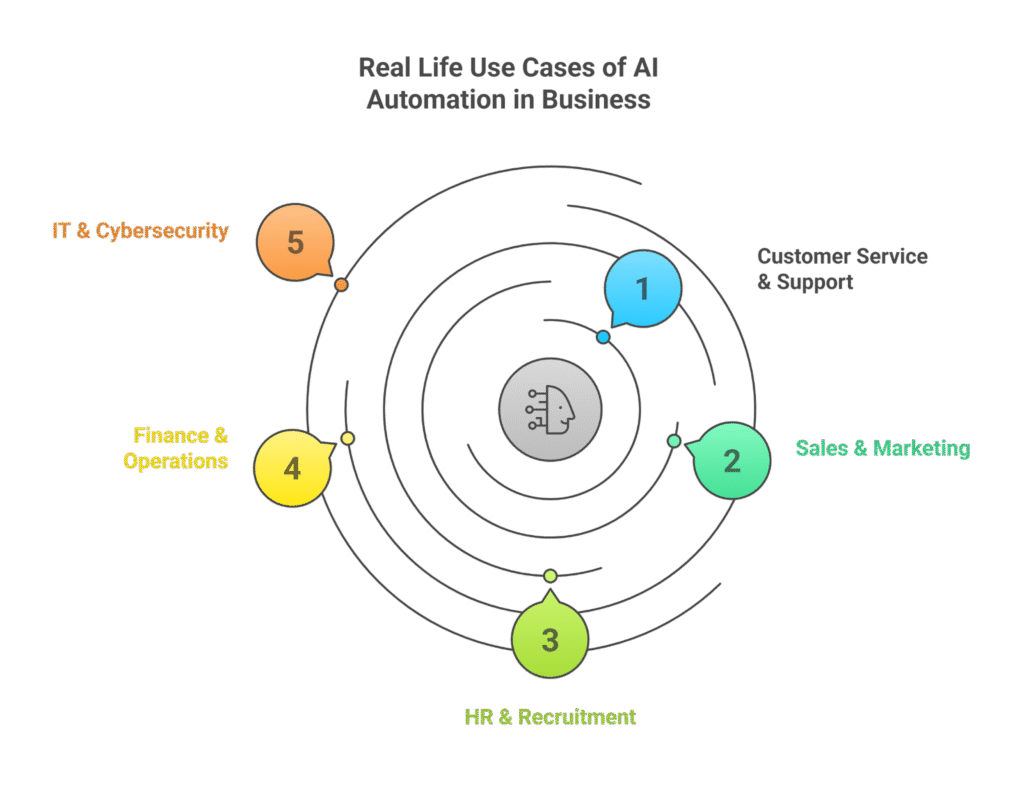
1. Customer Service & Support
AI-based automation is changing customer service by revolutionizing how companies interact with their customers.
- AI Chatbots and Virtual Assistants: Today’s AI chatbots, based on Natural Language Processing (NLP), can comprehend complex questions, deliver immediate and accurate answers to frequently asked questions (FAQs), and even process transactions around the clock. They are able to decrease the response time and increase customer satisfaction by instantly fulfilling requests or intelligently routing more challenging questions to human agents.
- Sentiment Analysis: By analyzing customer feedback across calls, emails, and social media, AI is able to decipher the emotional tone and detect trending issues. Businesses can also use it to proactively tackle issues and identify future trends.
2. Sales & Marketing
On the sales and marketing side, AI can replace guessing with highly targeted and tailored outreach at scale.
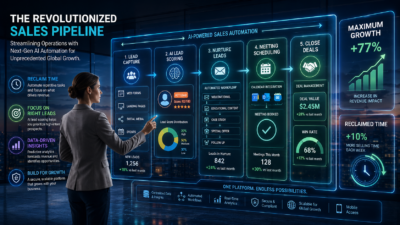
- Lead Qualification & Nurturing: AI can assess behavioral and demographic prospect information to score leads and find the best conversion probability candidates. It subsequently automates personalized email sequences and outreach, ensuring salespeople only spend time on the most realistic and attractive opportunities.
- Personalization of Content: AI makes hyper-personalization possible and allows websites to adapt to each visitor’s interests or emails to be tailored precisely to an individual’s past purchases and preferences.
3. HR & Recruitment
AI automation is enabling HR departments to be more strategic from recruiting to employee support.
- AI-Driven Candidate Screening: AI is able to examine thousands of resumés to filter for relevant skills and experience in a fraction of the time it would take a workforce to quickly short-list the top applicants. This significantly cuts down on that “grunt work” and gets initial hiring stages up and running more quickly.
- Onboarding & Employee Support: AI in HR can automate boring onboarding paperwork and offer real-time responses to basic HR questions, either within internal knowledge bases or chatbots. It liberates HR staff for more strategic work.
4. Finance & Operations
For departments that see high volumes of data and processes that are mission-critical to an organization, AI accuracy and scale are unprecedented.
- Automated Invoice Processing & Expense Management: Technology like AI (with or without OCR) can automatically pull data from invoices, compare it to the purchase order, and flag exceptions for approval. This helps reduce mistakes in data entry and speeds up financial processes.
- Fraud Detection: AI constantly analyzes transactions as they occur, learns what is considered normal in an organization, and looks for anything out of the ordinary that could signal fraud.
5. IT & Cybersecurity
AI is increasingly useful to safeguard digital assets and keep IT running smoothly.
- Automated Threat Detection & Response: AI is excellent at detecting network traffic and system logs if anything is off that could be malicious. It can pinpoint threats as they happen, and can even automate initial responses. This cuts cyber response times down significantly.
- IT Helpdesk Automation: Similar to customer support, internal IT help desks also use AI-driven chatbots to manage common questions automatically. These bots can escalate complex issues or route them to the right person when needed. It simply assures quicker settlement and minimal interference for employees.
When businesses use AI-based automation to simplify these sets of things, they’re not only optimizing discrete processes. They are building a business that can adapt more easily and generate greater profits over time.
We can learn a lot by looking at how AI automation is applied across multiple departments. But how can your business use it strategically?
How to Implement AI Automation: A Strategic Approach for Businesses
It’s clear that AI automation in business offers immense potential, but turning that potential into tangible business growth isn’t about simply buying the latest software. Successful AI adoption requires a thoughtful, strategic approach – a clear roadmap that guides you from initial ideas to impactful results.
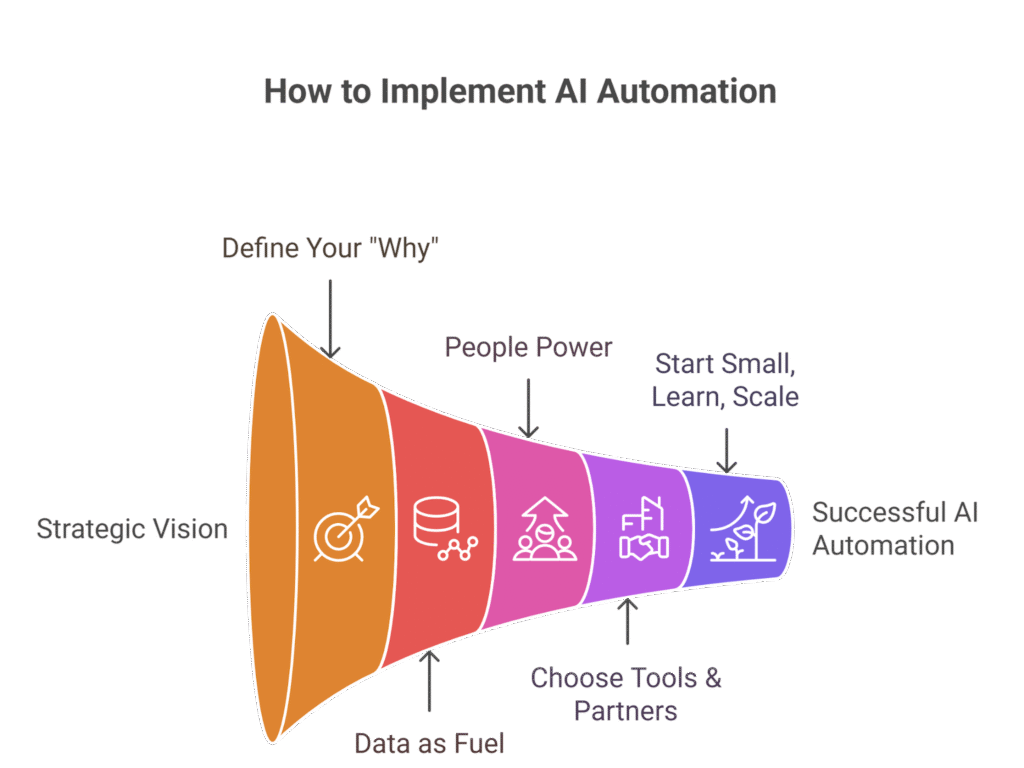
Step 1: Define Your “Why”
Before investing in any technology, the first and most critical step is to identify why you need it. Make sure there’s a clear purpose behind your automation efforts. Avoid using automation just because it’s available. Instead, pinpoint specific business problems or opportunities that AI can solve.
Do you need to reduce the time spent on customer support tickets? Speed up your invoice processing? Improve the accuracy of your sales forecasts? Define measurable objectives for each initiative.
For example, “reduce customer support response time by 30% within six months” is far more effective than “improve customer service.” Start small by identifying pilot projects that can demonstrate quick, visible wins. These early successes build confidence and provide valuable learning experiences before a wider rollout.
Step 2: Data is Your Fuel
AI systems are incredibly data-hungry. Their ability to learn, predict, and automate depends entirely on the quality, cleanliness, and accessibility of your data. If your data is messy, incomplete, or inconsistent, your AI will produce unreliable results.
This step involves assessing your existing data sources, addressing data silos (where different departments hold data separately), and ensuring consistent data formats. Crucially, consider data privacy and security from the outset. Protecting sensitive information is paramount and a non-negotiable aspect of any AI implementation.
Step 3: People Power
Perhaps the most overlooked aspect of AI implementation is the human element. AI automation is designed to augment human capabilities, not replace them entirely. Successful adoption hinges on preparing and empowering your employees.
Open and honest communication is vital to address any fears about job displacement and highlight how AI will free up staff for more engaging, higher-value work. Invest in training and upskilling programs to equip your team with the new skills needed to work with AI tools effectively. Create a culture of innovation where employees are encouraged to explore how AI can improve their daily tasks.
Step 4: Choose the Right Tools & Partners
The market is flooded with AI solutions, from off-the-shelf software to highly customized platforms. Choosing the right fit involves considering factors like scalability, ease of integration with your existing systems, and long-term support.
This is where the expertise of a specialized IT company becomes invaluable. A reliable partner can help you accurately assess your needs, understand the complexities of AI technologies, and develop customized solutions that seamlessly integrate into your current infrastructure. They can provide the technical know-how for implementation, data preparation, and ongoing optimization, ensuring your investment truly pays off.
CTA: Considering AI automation for your business? Nexifinity specializes in helping businesses set up these intelligent automation solutions from strategy to execution. Work with us to make sure the implementation process is easy and successful.
Step 5: Start Small, Learn, and Scale
Avoid the temptation to overhaul everything at once. A phased approach is almost always best. Begin with pilot projects to test your AI solutions in a controlled environment. Monitor their performance closely, gather feedback, and iterate based on what you learn.
AI models often need continuous refinement and training as new data becomes available or business needs evolve. This iterative process of testing, learning, and refining ensures that your AI-based automation initiatives are robust, adaptable, and continuously delivering value.
Once you’ve implemented AI automation, it’s important to track how well it’s working and what it means for the future of your business. Let’s look at how to measure success and where AI automation is headed next.
Measuring Success and The Future of Business with AI Automation
Once implemented, the real, lasting value of AI automation in business comes from consistently measuring its impact and understanding where this transformative technology is headed next.
1. Measuring the Value and Impact of AI Automation Investments
The return on investment (ROI) from AI automation extends beyond simple cost savings. While reducing operational expenses is a key benefit, its true power lies in the broader impact on your organization’s efficiency, quality, and strategic positioning. To effectively measure success, it’s crucial to establish clear Key Performance Indicators (KPIs) from the outset of any AI initiative.
Here are the key areas where you should measure the impact:
- Efficiency Gains: These are often the most straightforward to quantify. Look at metrics like:
- Reduced operational costs: Direct savings from automating repetitive manual tasks.
- Faster processing times: Quicker invoice cycles, reduced customer wait times, or accelerated data analysis.
- Error reduction rates: The decrease in mistakes and rework due to automated, precise processes.
- Enhanced Quality & Experience: These “softer” metrics are equally vital for long-term success:
- Improved customer satisfaction scores (CSAT, NPS): Are customers happier with faster responses and more personalized service?
- Better employee engagement: Are your employees feeling more valued and productive because mundane tasks are handled by AI, freeing them for higher-value work?
- Higher accuracy: Has the quality of your output improved due to AI’s precision?
- Strategic Advantages: AI opens new avenues for growth and competitive edge:
- Increased revenue: Has AI-enabled faster service delivery, new product development, or more effective sales strategies?
- Improved data insights: Are your business decisions more informed and impactful due to AI-driven analytics?
- Enhanced compliance and reduced risk: Has AI helped you adhere to regulations more effectively or identify potential issues proactively?
By tracking these KPIs, you can clearly demonstrate the tangible benefits of your AI-based automation investments and identify areas for further optimization.
2. What’s Next in AI Automation?
AI is not a static technology. It’s a rapidly evolving field that continuously reshapes business possibilities. Keeping up with new trends is essential for planning ahead effectively.
- Hyper Automation: This concept goes beyond automating individual tasks. It’s a focused, business-oriented strategy aimed at quickly finding and automating every task that can be streamlined. This is done using advanced technologies like AI, Machine Learning, Robotic Process Automation (RPA), and other smart tools. The aim is to build a fully connected and automated system that works smoothly throughout the entire organization.
- Autonomous AI Agents: AI systems are advancing toward the ability to handle complex, multi-step tasks on their own. They can make decisions and adapt along the way with very little human involvement.
- Ethical AI and Governance: As AI becomes more powerful and integrated, the importance of responsible AI development grows. This includes ensuring fairness, transparency, and accountability in AI systems, mitigating biases, and protecting data privacy. Prioritizing ethical guidelines builds trust and ensures long-term, positive impact.
3. Partnering for Long-Term Success
To truly stay ahead and maximize your AI automation investments, partnering with experienced specialists is invaluable. A dedicated IT company specializing in AI-based automation can provide the following:
- Strategic guidance: Helping you understand future trends and identify new opportunities for AI adoption.
- Technical expertise: Ensuring your AI systems are optimized, scalable, and secure.
- Ongoing support: Providing maintenance, updates, and assistance with ethical considerations.
AI automation is not merely a project to be completed. By continuously refining your AI strategies and partnering with the right experts, you can ensure sustained growth, maintain a competitive edge, and unlock your organization’s full potential in the automated future.
Conclusion
The transition to AI automation might seem intricate, but as this guide has shown, it presents significant opportunities for growth. We’ve explored how AI automation in business goes beyond simple task execution and adds intelligence and adaptability to your operations. From enhancing customer service and boosting sales and marketing to streamlining HR, finance, and IT functions, AI is fundamentally changing how businesses run.
Successful implementation isn’t just about the technology itself. It requires a clear strategy that includes defining goals, ensuring data readiness, and preparing your workforce.
By starting with pilot projects, continuously measuring ROI across efficiency, quality, and strategic advantages, and staying informed about emerging trends like hyper automation, businesses can achieve lasting competitive advantage.
Ready to integrate AI automation and achieve significant growth for your business? At Nexifinity, we specialize in helping businesses set up automation solutions, ensuring seamless integration and measurable results. Contact us today for a free consultation and discover how AI can transform your operations.